
From the outside, Frank was doing well. He was in a senior role, well respected, leading a well-functioning department and getting things done. Colleagues typically described him as steady, thoughtful, undramatic, effective.
For him, though, something was off. It wasn’t “I want to resign” or anything but he just didn’t feel like his leadership had evolved in “the right way”. He knew things would change as he got more experienced, moved into different roles and the company changed but – in his words:
“I feel like I’ve regressed rather than grown recently”
Of course everyone is different and so every coaching engagement is different but if I were to ruthlessly categorise I would say there’s two types of coaching. Firstly there’s the person that wants to take action on something specific…like increase their presence or prepare for a new role.
Secondly there’s the person who has more of a longer-term partnership with a coach. As a regular sounding board or working on something a little more strategic like evolving their leadership styles to include a more delegative, enabling aspect for example.
Frank used to be in that second camp – we worked together for a while a couple of years ago – but had recently got in touch with this sort of nagging feeling that something wasn’t quite right.
I got Frank to explain a bit more about what he meant. He explained how he used to leave meetings quite energised but now he often left feeling “a bit flat”. He felt like he was spending more of his energy over-thinking decisions or playing politics than getting on with what he felt was “real leadership”.
And yet everyone else still felt he was doing a good job. It was just him that felt otherwise. It was this disconnect that led him to get in touch again.
Because it had been a couple of years since our last session, I felt it was a good opportunity to revisit his personal definition of leadership and his values. Had they changed over the last couple of years?
He was able to dig out what he called his “leadership mantra” that he created in our coaching sessions some years ago:
“I’m the kind of leader who provides direction and purpose and creates space for my people to determine the path. I treat my people as adults, trusting them to handle the truth and agency while role-modeling the behaviours I expect from others.”
He said this hadn’t changed although when reading it again he felt there was a growing gap between this vision and his current reality.
I describe this as “leadership drift” and it can be surprisingly hard to spot when you’re in it. Very few people make a conscious choice to step away from who they want to be; it’s usually a series of small micro-decisions, micro-compromises that are not noticeable or at least easy to rationalise or justify.
I asked him when he first started noticing this feeling that things weren’t quite right.
He thought for a while and then started talking about a recent senior reshuffle which has created more uncertainty and led to more pressure from above and more urgency.
As he talked, he identified situations where he’d become more cautious:
He would go into meetings with a pretty clear view on something and come out having said a more diluted version of it.
He was more likely to frame concerns as questions
He was more likely to present challenge as curiosity
He was more likely to let things slide rather than cause a fuss.
Without realising it, Frank had already started working his way through the Calm REBEL Arc.
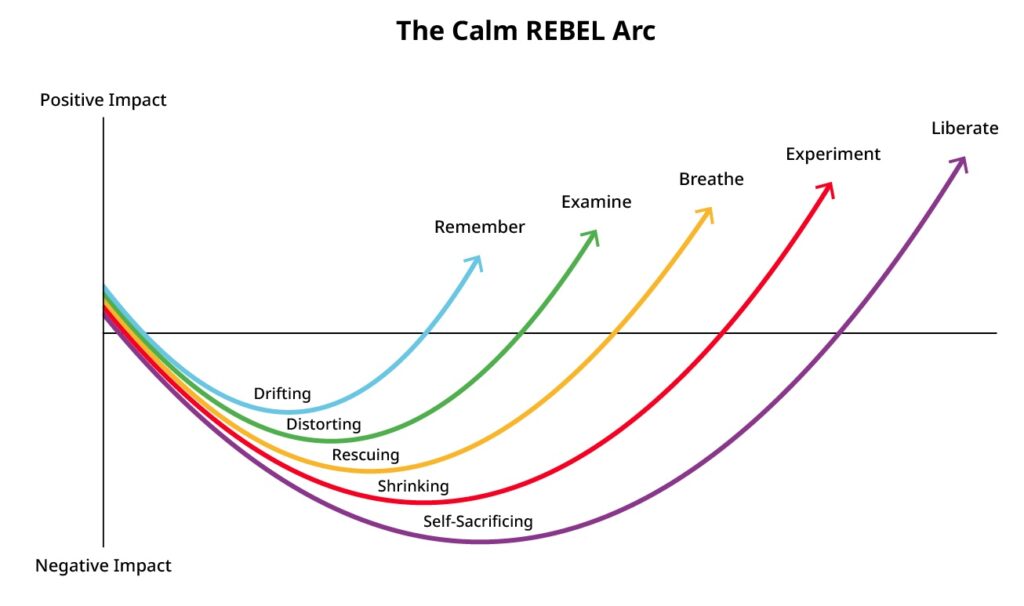
The first part of the arc is Remember and he had already reminded himself of the version of leadership that was important to him. This had already given him valuable insight but, seeing as he was in a coaching session, he had a safe space to explore further.
Coaching is often a great space to really Examine things a bit more objectively. Frank could look at his current reality in a calm setting and with a neutral party (me) to get underneath that general feeling of unease.
Once Frank had reconnected with the kind of leader he actually wanted to be, we started looking a bit more objectively at his situation in a bit more detail.
When he really examined what had been going on for him since that leadership change, he identified a few assumptions that he had been working under without realising it.
There were two in particular that stood out:
He needed to build up the trust others in the leadership team had in him before he could be himself
The more senior you become, the less idealistic and disruptive you can afford to be
Of course, both of those assumptions could be true but they could just as likely be false so I encouraged him to really pick them apart a bit based on what he knew about his situation and, in particular, his view of leadership.
By coming to coaching he had given himself chance to Breathe (the 3rd part of the Calm REBEL Arc) and now he could begin to Experiment.
This is where I think people can sometimes get the wrong idea about change. Frank didn’t need to suddenly become a different person or make some grand, risky stand. He didn’t need to “be more rebellious”in an obvious or theatrical way.
He just needed to test reality a little.
In Frank’s case, the obvious place for that experiment was the leadership team itself because that was where he had noticed the drift most clearly.
He had described going into meetings with a clear view and coming out having said a watered down version of it. So the experiment was simply this: in one upcoming leadership meeting, Frank would say what he actually thought earlier and more plainly than usual.
Not aggressively, just without the filter.
He knew there was a decision coming up where he had genuine concerns about the likely impact. He felt that having noticed his recent pattern he would probably frame those concerns as gentle questions, soften the edges, and leave the room feeling that he had technically raised them without really feeling he’d done his job.
This time, he decided he would:
Name his concerns directly.
Be specific about the trade-off he could see.
Resist the urge to over-explain.
When we spoke again afterwards, he was happy with how the meeting had gone. The team had still decided to go with the decision but Frank was happy that the trade-off was explicitly acknowledged and most importantly, he left the meeting without that flat feeling that he was getting used to after diluting his views.
The experiment wasn’t to “win” or change the culture. It was to test whether he could interrupt his pattern by testing the assumptions that were influencing his actions.
He had some proof that he didn’t need to be more trusted before he could be himself and that he could be a bit more disruptive without negative consequences.
What coaching gave him, in that moment, was not a perfect answer but a chance to see that another way of showing up was still available to him.
And that is often how people start to Liberate themselves a little. Feeling a little freer to be yourself and leading like themselves again.