

When I talk to leaders about their organisation’s leadership problems many executives are ok with the messages when I say:
“Your leaders are stressed.”
“People are burning out.”
“You need resilience.”
They kind of already know this. They might even be feeling those things themselves (though probably wouldn’t admit it).
What’s more difficult for these people to accept is the possibility that some of the behaviours their organisation currently rewards could be the very things pulling good leaders away from good leadership.
It’s easy to demonise other people and even systems but it’s rare in my experience that any system is inherently evil. It’s also highly likely in my experience that the company values and official culture are bought into.
Unfortunately though, it’s the systems themselves that shape behaviour (and mood) whether we acknowledge it or not.
A capable leader joins an organisation wanting to lead well. They want to think clearly, make thoughtful decisions, develop people and create meaningful work.
Then slowly, and often so gradually they barely notice it, the system starts teaching them something else.
Be fast…be certain…don’t upset the seniors…keep moving…be resilient…be available…always have an answer…failure is not an option.
People pay attention to what happens
Naturally people pay attention to what actually happens rather than what we say happens…so they drift.
The next problem is that this drift is often rewarded at first. The leader who says yes becomes “can do”. The leader who absorbs pressure becomes “reliable”. The leader who quietly carries impossible workloads becomes “senior enough”.
This then sends signals everywhere about what is accepted and expected. Behaviour elsewhere then trends towards that and, other leaders start to get a distorted view of what is good and how they should show up.
Indeed many organisational problems are not really capability problems but rather adaptation problems.
Organisations often respond to these problems as though individuals are failing. So they offer more training or performance management. In reality though the people are adapting quite rationally to the environment they’re in.
If the system repeatedly rewards certainty over honesty then people become find the metrics that tell a good story. If it rewards availability over sustainability then people become exhausted. If challenge feels politically dangerous then eventually only safe conversations survive.
Eventually those adaptations become culture which unsurprisingly leads to a whole host of unwanted downstream effects including but not limited to artificial urgency, performative busyness, burnout hidden behind competence, disengagement and churn.
The problem with resilience
One of the more dangerous myths in modern organisations is the idea that resilience means individuals simply becoming better at coping with unhealthy environments.
That framing is convenient because it keeps the responsibility located inside the individual.
If somebody is exhausted, they need better boundaries.
If somebody struggles under pressure, they need resilience training.
Maybe we’ll run a “psychological safety audit” and “open the communication channels” again.
Everyone’s fine? OK…carry on.
Of course those things can genuinely help but organisations also need the maturity to ask:
“What is our system repeatedly asking human beings to become in order to survive here?”
Most organisations don’t collapse because of one catastrophic leadership failure just like no leader turns up thinking “I’m going to completely betray my values”. They slowly drift into patterns that feel normal internally while becoming increasingly unhealthy and ineffective over time.
Another issue I see is that “leadership development” often focuses heavily on visible behaviours or “leadership toolbox skills” like presentation skills, executive presence, stakeholder management and influencing.
Don’t get me wrong – they are all very valuable (and things I teach and coach…wink) but what’s more important, in my opinion is helping leaders become more capable of retaining judgement, self-awareness, courage and humanity under pressure.
Let’s be honest, anybody can sound values-driven in a calm environment but pressure is where leadership identity and culture is tested.
Calm REBEL Leadership is not anti-organisation
When I wrote Calm REBEL Leadership, many people read it as “the system” (and therefore the organisation) is the villain and they tended to gloss over the fact that the system is rarely inherently evil.
This is normal as they are looking at it through their own lens but as a result Calm REBEL Leadership is sometimes misunderstood as encouraging rebellion against organisations themselves.
It is not.
As well as being a rallying cry to thoughtful leaders who have been slowly beaten down by the system, I believe my book is just as importantly a rallying cry for organisations who don’t realise what their systems are doing to their best leaders.
Healthy organisations need thoughtful, grounded, emotionally aware leaders more than ever. Modern organisations operate in environments filled with uncertainty, ambiguity, rapid change and competing pressures. The answer to that complexity is not emotionally disconnected leadership or endless command-and-control behaviour disguised as urgency.
It is leaders who can stay steady without becoming passive, adaptive without losing themselves and courageous without becoming combative.
I hope I don’t need to spell out how valuable effective leadership is to an organisation but the evidence is suggesting that perhaps someone does.
I don’t think the organisations that thrive over the next decade will necessarily be the ones that squeeze the most from people. I think they’ll be the ones that realise that systems shape people whether they intend to or not and become intentional about what kind of leaders their environment is slowly creating.
Stay Calm. Stay Rebellious
A Case Study About Leadership Drift
From the outside, Frank was doing well. He was in a senior role, well respected, leading a well-functioning department and getting things done. Colleagues typically described him as steady, thoughtful, undramatic, effective.
For him, though, something was off. It wasn’t “I want to resign” or anything but he just didn’t feel like his leadership had evolved in “the right way”. He knew things would change as he got more experienced, moved into different roles and the company changed but – in his words:
“I feel like I’ve regressed rather than grown recently”
Of course everyone is different and so every coaching engagement is different but if I were to ruthlessly categorise I would say there’s two types of coaching. Firstly there’s the person that wants to take action on something specific…like increase their presence or prepare for a new role.
Secondly there’s the person who has more of a longer-term partnership with a coach. As a regular sounding board or working on something a little more strategic like evolving their leadership styles to include a more delegative, enabling aspect for example.
Frank used to be in that second camp – we worked together for a while a couple of years ago – but had recently got in touch with this sort of nagging feeling that something wasn’t quite right.
I got Frank to explain a bit more about what he meant. He explained how he used to leave meetings quite energised but now he often left feeling “a bit flat”. He felt like he was spending more of his energy over-thinking decisions or playing politics than getting on with what he felt was “real leadership”.
And yet everyone else still felt he was doing a good job. It was just him that felt otherwise. It was this disconnect that led him to get in touch again.
Because it had been a couple of years since our last session, I felt it was a good opportunity to revisit his personal definition of leadership and his values. Had they changed over the last couple of years?
He was able to dig out what he called his “leadership mantra” that he created in our coaching sessions some years ago:
“I’m the kind of leader who provides direction and purpose and creates space for my people to determine the path. I treat my people as adults, trusting them to handle the truth and agency while role-modeling the behaviours I expect from others.”
He said this hadn’t changed although when reading it again he felt there was a growing gap between this vision and his current reality.
I describe this as “leadership drift” and it can be surprisingly hard to spot when you’re in it. Very few people make a conscious choice to step away from who they want to be; it’s usually a series of small micro-decisions, micro-compromises that are not noticeable or at least easy to rationalise or justify.
I asked him when he first started noticing this feeling that things weren’t quite right.
He thought for a while and then started talking about a recent senior reshuffle which has created more uncertainty and led to more pressure from above and more urgency.
As he talked, he identified situations where he’d become more cautious:
He would go into meetings with a pretty clear view on something and come out having said a more diluted version of it.
He was more likely to frame concerns as questions
He was more likely to present challenge as curiosity
He was more likely to let things slide rather than cause a fuss.
Without realising it, Frank had already started working his way through the Calm REBEL Arc.
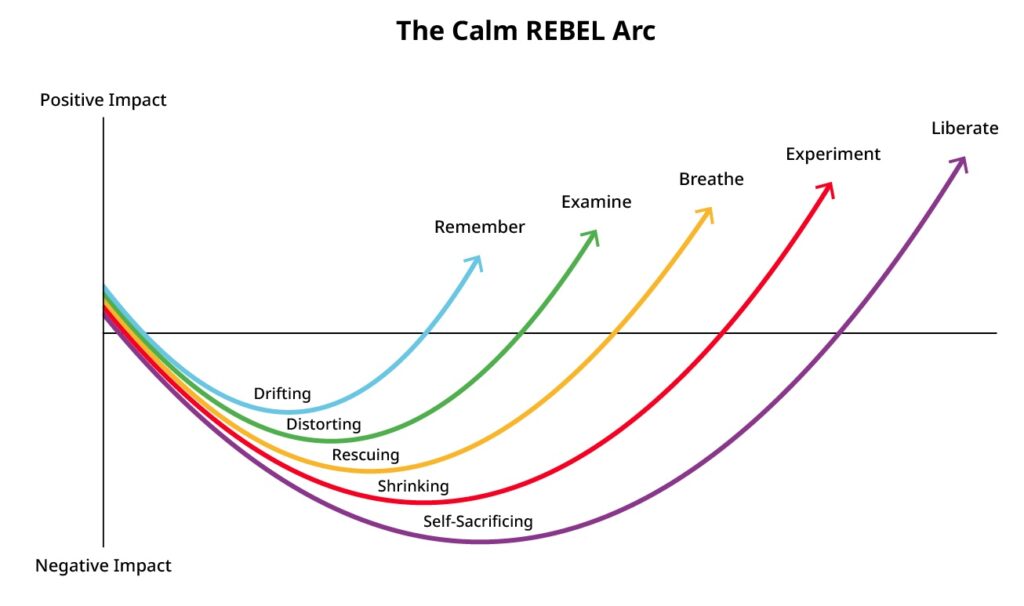
The first part of the arc is Remember and he had already reminded himself of the version of leadership that was important to him. This had already given him valuable insight but, seeing as he was in a coaching session, he had a safe space to explore further.
Coaching is often a great space to really Examine things a bit more objectively. Frank could look at his current reality in a calm setting and with a neutral party (me) to get underneath that general feeling of unease.
Once Frank had reconnected with the kind of leader he actually wanted to be, we started looking a bit more objectively at his situation in a bit more detail.
When he really examined what had been going on for him since that leadership change, he identified a few assumptions that he had been working under without realising it.
There were two in particular that stood out:
He needed to build up the trust others in the leadership team had in him before he could be himself
The more senior you become, the less idealistic and disruptive you can afford to be
Of course, both of those assumptions could be true but they could just as likely be false so I encouraged him to really pick them apart a bit based on what he knew about his situation and, in particular, his view of leadership.
By coming to coaching he had given himself chance to Breathe (the 3rd part of the Calm REBEL Arc) and now he could begin to Experiment.
This is where I think people can sometimes get the wrong idea about change. Frank didn’t need to suddenly become a different person or make some grand, risky stand. He didn’t need to “be more rebellious”in an obvious or theatrical way.
He just needed to test reality a little.
In Frank’s case, the obvious place for that experiment was the leadership team itself because that was where he had noticed the drift most clearly.
He had described going into meetings with a clear view and coming out having said a watered down version of it. So the experiment was simply this: in one upcoming leadership meeting, Frank would say what he actually thought earlier and more plainly than usual.
Not aggressively, just without the filter.
He knew there was a decision coming up where he had genuine concerns about the likely impact. He felt that having noticed his recent pattern he would probably frame those concerns as gentle questions, soften the edges, and leave the room feeling that he had technically raised them without really feeling he’d done his job.
This time, he decided he would:
Name his concerns directly.
Be specific about the trade-off he could see.
Resist the urge to over-explain.
When we spoke again afterwards, he was happy with how the meeting had gone. The team had still decided to go with the decision but Frank was happy that the trade-off was explicitly acknowledged and most importantly, he left the meeting without that flat feeling that he was getting used to after diluting his views.
The experiment wasn’t to “win” or change the culture. It was to test whether he could interrupt his pattern by testing the assumptions that were influencing his actions.
He had some proof that he didn’t need to be more trusted before he could be himself and that he could be a bit more disruptive without negative consequences.
What coaching gave him, in that moment, was not a perfect answer but a chance to see that another way of showing up was still available to him.
And that is often how people start to Liberate themselves a little. Feeling a little freer to be yourself and leading like themselves again.

When Adaptation Becomes Drift
I’ve been giving a few talks at Meetup groups recently about Calm REBEL Leadership and one part seems to have really resonated.
A lot of people identify with the first trap: Drifting.
A common response is: “I didn’t realise I’d drifted so much.”
That’s probably because Drifting rarely looks dramatic. It shows up as small compromises in who we are, what we believe, and what we stand for in our leadership.
In the moment, they look sensible. Flexible. Pragmatic. Like being a good team player and not causing a fuss…
“Just this once…” you tell yourself.
Sometimes that is exactly the right thing to do. The trouble is that drifting has a way of becoming invisible. One day you’re adapting and, before you know it, you’re complying.
A little later, you can’t quite remember when you stopped saying what you really think.
The first thing to know is that this is normal. Not every drift is dangerous, but some are worth interrupting.
In the book, Emma stops her drift by remembering what is important to her as a leader and putting those aspects of her leadership into clearer view.
She remembered, when she was at her best she:
tells the truth, even when it’s uncomfortable.
makes work feel meaningful, not just efficient.
doesn’t let cynicism win.
By remembering this and putting a sticky note on her wall and notebook to keep it in view, she could ask herself:
Would truth-telling Emma stay silent in this meeting?
Would meaningful-work Emma go along with this just to keep the peace?
Would don’t-let-cynicism-win Emma shrug and say, “that’s just how it is”?
The trick isn’t never to drift. It’s to notice sooner.
To catch that moment where you realise: I’ve been moving with the current for a while now.
Do I still want to be going this way?
Turn it off…or don’t!
I went to see The Book of Mormon again recently. I describe it as quite possibly the best thing I’ve seen (movies, sports events, concerts) and that’s why I’ve seen it multiple times.
On the surface, it’s a comedy about two young missionaries but as some of you who know me won’t be surprised to see me write…really it’s a story about agile leadership.
I will try not to give away any huge spoilers (but even if I gave you the whole story you would still thoroughly enjoy it!)
Elder Price begins with certainty — armed with a perfect script and a desire to change the world for good.
Then their mission begins, and the world doesn’t follow the story he’s been told.
At first, he doubles down, preaches harder, and, like everyone around him when faced with doubt and discomfort, tries to “Turn It Off.”
When you start to get confused because of thoughts in your head, Dont feel those feelings! Hold them in instead
Turn it off, like a light switch just go click! Its a cool little Mormon trick! We do it all the time
When you’re feeling certain feels that just dont feel right Treat those pesky feelings like a reading light and turn em off, Like a light switch just go bap! Really whats so hard about that?
Turn it off!
I love the humour and ironic truth in that song.
We can rationalise “turning it off” as ‘discipline’ or ‘being resilient’ but really it’s denial and drifting from who we really are and could be. The problem is that many systems reward it — the ability to smile through dissonance, to suppress doubt, to keep the story going even when it no longer fits.
Just like Elder Price we then start to doubt ourselves rather than the system. We start to think we are the problem – that’s distorting. And the system quite often rewards and reinforces that too.
Looking through my biased lens I also saw the traps of rescuing, shrinking and self-sacrificing before the Elders embark on the Calm REBEL Arc.
But when the pretending stops, something better begins. Elder Price remembers why he came — to help, not to perform.
He examines what’s real, not what’s expected and when the system tries to pull him back into compliance, he chooses something braver: liberation
He decides to join Elder Cunningham in shaping a new story — one that may not be factually correct, but is humanly true.
Because leadership isn’t about defending the official version. It’s about helping people find meaning that still works.
Stay Calm. Stay Rebellious. And remember…tomorrow is a latter day!
The Calm Rebellion of Empathy
A leader I’ll call Sarah* was passionate about agility from the start. She believed in servant leadership, in creating space for her teams to self-organise, and in measuring success by outcomes, not just output.
Her teams had always responded well. They were motivated, collaborative, and even began finding innovative ways to reduce delivery risks. For a while, it felt like everything was on track.
But the pressure from senior management soon mounted. Governance meetings became more about optics than learning. Targets and deadlines were imposed from the top, often without context. Sarah found herself pulled into endless reporting cycles where the message was clear: control matters more than trust.
At first, she tried to protect her teams from the worst of it but over time, the pressure began to wear her down. She became more cautious, second-guessed her decisions and found herself enforcing processes she didn’t believe in, just to avoid awkward conversations.
She described it as “leading with the handbrake on.”
It felt like Sarah and the senior leadership were at odds with one another
The Trap
Sarah had fallen into a couple of common leadership traps.
Firstly she started Drifting. This is where she made the odd small compromise of her values. She told herself it was to avoid unnecessary conflict and ensure initiatives weren’t killed off too quickly. This is completely normal.
She was also experiencing what I call the Distorting Trap — where systemic pressure makes leaders start doubting their own judgment. The very instincts that made her a strong agile leader — empowering others, trusting collaboration, leaning into uncertainty — were the same ones she was now questioning.
The Turning Point
When we spoke about the Calm REBEL Arc, the step that lit something in her was Examine. Instead of swallowing the system’s narrative whole, she began to look at it with clearer eyes.
Initially, Sarah assumed her senior leaders were driven by values directly opposed to her own — that they cared about control, not trust; deadlines, not learning. But when she slowed down and put herself in their shoes, she realised something important: they too were under pressure.
Their push for deadlines and optics wasn’t born of hostility toward agility. It was the result of their own drift from core values — their own distorted lens – and that this was driven by the pressure they felt.
She also reflected that she was acting less in line with her values than she assumed she was. She had started to view those interactions with “the control freaks” as she had begun to call them as adversarial “battles”.
Experiments in Empathy
From that insight, Sarah began a new set of experiments.
• In steering meetings, instead of framing leaders as adversaries, she assumed underlying positive intent. She asked questions that revealed where their anxieties were coming from, and acknowledged those pressures openly.
• She deliberately built rapport, emphasising shared goals: value for customers, reduced risk, sustainable delivery.
• She brought her team into governance updates, letting executives experience their capability firsthand.
These weren’t acts of open defiance. They were calm, values-led moves that allowed her to act more in line with her principles of connection and trust — while giving her seniors the space to trust others, too.
Removing the distorted lens imposed by the system through empathy, a new relationship of allyship could be created.
The Ripple
The change was slow but noticeable. Her executives began to see Sarah not as a challenger to be managed, but as an ally who could help them meet their own goals without sacrificing integrity. Her teams saw her modelling servant leadership again, even under pressure.
Within six months, the teams were more trusted, not less. And Sarah herself described it as “leading without the handbrake” once more.
Why This Matters
Sarah’s story is not unusual. Many agile leaders start with conviction, only to find their voice distorted by governance demands and optics-driven pressure. It can feel like the only options are to conform or to burn out.
Admittedly not always, but sometimes there is another way. By examining the system clearly — and empathising with the fact that everyone is under pressure — leaders can create steady, values-led experiments that satisfy governance needs while protecting agility.
The result often isn’t just personal recovery. When one leader assumes positive intent and models trust, it ripples upward and outward. Others remember what they stand for, too.
Start with Empathy
If you’ve ever felt your agile leadership being stifled, try starting from empathy. Both for yourself and others. Sometimes the quietest act of rebellion is to treat even your most demanding stakeholders as partners — and in doing so, free everyone to lead more authentically.
* Not her real name but story shared with permission
The Cost of Being the Reasonable One
When Priya* got back in touch, I was genuinely pleased to hear from her. We’d worked together a couple of years earlier, during a time when she was stepping into a more senior role. Back then, I remember her being clear-headed, quietly confident, and fairly unapologetic about the kind of leadership she wanted to model — calm, thoughtful, and values-led, even if it meant slowing things down or being the awkward one in the room.
*Name changed — story shared with permission
So when she emailed to ask about picking up some coaching again, I assumed it was for the usual reasons — career direction, new team, maybe thinking about a move. But when we met, it was clear something had shifted.
She hadn’t crashed and there definitely wasn’t a crisis but she seemed… dimmed somehow.
“I’m still showing up. I’m still doing the job. But I don’t think people see me in the same way anymore. I don’t even think I do.”
The Slow Disappearance
Over the next couple of sessions, we pieced it together.
There hadn’t been a single moment when things changed. There wasn’t a blow-up meeting or a conflict with a manager. It was just a gradual fading of the version of her that used to be more deliberate, more questioning, more visible. I call it Shrinking and Priya described it as:
“Bit by bit, I’ve become easier to work with. More agreeable and less trouble. I feel like somewhere along the way, I stopped adding anything that felt properly mine.”
The bigger problem for Priya is that it felt like it was working because people did like working with her, she was praised for her calmness, her pragmatism, her reliability.
She’d become a sort of internal safe pair of hands but the cost was starting to show.
She wasn’t sure what she stood for anymore or if she’d even notice if she compromised something important — because it had been so long since she’d drawn a firm line.
Who She Used to Be
This was one of those times in coaching where I already had a benchmark. I’d seen her before, and that helped us both reflect more honestly.
Back when we first worked together, Priya was someone who would stop a team mid-sprint to ask if the work still made sense. She’d gently challenge a stakeholder on unrealistic expectations and, while she wasn’t loud, she was anchored.
Now, she said, she often found herself nodding along — even when something didn’t feel right. When we talked it through, she reflected that she had slowly learned that questioning things slowed people down. She told me about how over time she had been told a number of times that naming risks made her the “negative one.”
So she backed off. Not all at once, but incrementally.
“I thought I was being smart, adapting to the culture. But now I’m not sure there’s anything left of me in the way I lead.”
Reclaiming a Bit of Ground
We didn’t try to bounce back to the “old Priya” straight away.
Instead, we talked about whether there were still places in her work where she felt like herself. What parts of her job felt authentic, and which ones felt like she was playing a role.
For example the one-to-one conversations with her team — especially when she was mentoring someone or helping them think through a tough decision. She wasn’t trying to impress anyone or perform leadership — she was still showing up as herself.
Meanwhile, in the all-hands updates she found herself using language she didn’t really believe in, trying to sound upbeat and aligned, even though deep down she wasn’t sure the current direction made sense
There was no breakthrough moment. But there was a shift in posture — from “how do I get back to being me?” to “where might I already be?”
Over time, she started doing a few small things differently. Nothing dramatic — just little reclaims.
She began preparing what she wanted to say in meetings, even if she didn’t get to say it all. That helped her notice whether she was truly holding back or just staying quiet out of habit.
When deadlines felt rushed, she started asking one simple question: “What are we assuming will happen if we go slower?” Not a challenge, just curiosity. But it gave her space.
She also reconnected with one of her newer team leads, someone she’d been coaching half-heartedly. She leaned back in, offered clearer support, and found that those interactions still lit her up.
These weren’t revolutionary, and in some cases they went unnoticed by others. But they mattered to her.
“It’s not like I’ve stepped back into my old self. It’s more like… I stopped letting the system erase me completely.”
A Familiar Pattern
If you’ve seen yourself in any of this, it’s important to realise that this isn’t about weakness as such.
Shrinking is a natural reaction to spending too long in a system where we are the ‘odd one out’.
And for some people, that shrinking happens faster.
Women and other minorities in the workplace often carry an extra layer of expectation — to be collaborative, not confrontational; to be flexible, not forceful; to conform.
The system doesn’t always say it out loud, but there is a gravitational pull back to the status quo and equilibrium. The system has a way of showing people what’s welcomed and what’s not and that means knocking the sharp edges off anyone different.
If you’re already one of the fewer voices in the room, you learn quickly which parts of yourself to turn down.
We rationalise that shrinking will make things easier, that it will protect our position, that it will smooth the road for the people around us. It’s a sensible adaptation but over time, it can become self-erasing.
You stop showing people what matters to you, and eventually they stop asking.
No Roar Required
What Priya needed wasn’t a career overhaul or a leadership masterclass. She just needed to hear herself again.
And that’s what Calm REBEL Leadership is really about.
It’s not about blowing things up or quitting in a blaze of glory.
It’s about spotting where you’ve drifted and finding a few places to bring yourself back…quietly and deliberately.
If that’s something you’re ready to explore — through coaching, a workshop, or simply by reading the book — then let’s talk.
Because you don’t have to roar but you do deserve to be heard.
The Firefighter Who Lost His Spark
When I first met Ian*, he described himself as being “basically the fire brigade for my company.”
* Name changed for anonymity but permission given to use this story
It wasn’t a throwaway line. Through our coaching conversations, the firefighting metaphor kept popping up — burning issues, flames to put out, hoses that wouldn’t stretch far enough. If I’d had a pound for every fire reference, I could have bought him his own fire engine.
The thing is, Ian wasn’t wrong. He really was the person everyone called when things went wrong. Of course that made him indispensable, and gave him a sense of satisfaction but it also left him drained. Somewhere along the way, this firefighter lost his spark (pun intended).
Always on Call
Ian ran a department in a financial services firm. His reputation as “the reliable one” meant work gravitated towards him. He did well out of it – promotions followed – but so did pressure and unintended consequences.
He told me early on:
“I used to feel proud of how I stood up for my team. Now I just feel like I’m running around with a leaky hose. No matter how much I do, the flames keep coming back.”
Personally I think that metaphor call-back was a bit weak and it was meant as a joke, but you could hear the exhaustion underneath it.
Ian’s tendency to rescue didn’t come out of nowhere. Like many conscientious leaders, he had some deeply laudable traits: he wanted to please people and he took pride in being the person others could rely on.
In moderation, those qualities made him a supportive, dependable leader but in his organisation, and coupled with a deep need for validation, those qualities were amplified.
The system encouraged his rescuing behaviour — colleagues thanked him for stepping in, managers praised him for “always delivering,” and his reliability became part of his professional identity. Every time he sacrificed his own boundaries, the organisation rewarded him. Every time he picked up the slack, he was validated.
It’s easy to see how this cycle reinforced itself: the more he rescued, the more he was applauded; the more he was applauded, the more he felt he had to keep rescuing. (I know it sounds like I’m writing a management textbook, but honestly it’s just the way Ian described it.)
The tragedy was that, over time, these “heroics” took him further away from his true leadership style. The values that had once grounded him — developing others, strategic thinking, collaboration and autonomy — were gradually pushed aside in service of being the firefighter.
The Hidden Cost of Saying No
Where things got really tough for Ian was the flip side: the times he tried not to rescue.
The first time he deliberately let his team present their own imperfect work, he was told he was “dropping standards.” When he questioned whether a new request was realistic, he was branded “negative.”
So rescuing wasn’t just encouraged — it became compulsory. The moment Ian tried to act differently, he felt punished.
Maybe It’s Just Me
Although I didn’t know him at his best, by the time Ian came to coaching, he was already looking like the system had worn him down.
“What if I’m not cut out for this? What if I’m the problem?”
That question — maybe it’s just me — is one I hear a lot. When every attempt to step back is punished, it’s easy to assume you’re the one at fault. But in Ian’s case (and in most cases), the problem wasn’t him. It was the system rewarding the very behaviours that drained him, and discouraging the ones that aligned with his values.
Creating a Firebreak
We didn’t start with sweeping changes. Ian didn’t need to escape the building; he needed to create some space between himself and the flames. A firebreak. (His metaphor has infected me by now…)
So we focused on small acts of rebellion…
Naming his non-negotiables. For Ian, that meant no weekend emails and starting to give his team honest feedback again, even if it ruffled feathers. Those were the values he refused to compromise on.
Marking out pockets of integrity. Instead of trying to extinguish every blaze across the business, he chose one project where he could lead with more autonomy and collaboration. This became his “controlled zone” — a place where the fire couldn’t spread.
Testing the edges. He experimented with stepping back from certain rescues. When asked by senior leaders to “tidy up” a report his team had produced, Ian resisted the urge to rescue and let it go forward as it was. He got the predictable comment about “dropping standards,” but his team saw that he backed them.
Each of these small actions built Ian’s firebreak wider and stronger. It wasn’t dramatic, but it began to restore the oxygen he’d been missing.
I’m stretching the metaphor now, but you get the point.
Rekindling His Spark
Over time, Ian began to reclaim pieces of himself.
He still cared deeply and he was still reliable but those traits were no longer the whole story. By protecting small spaces where he could lead differently — coaching his team instead of fixing their mistakes, carving out time for strategic thinking — he began to feel more like himself again.
The flames didn’t go away and the system didn’t suddenly change but Ian did. He stopped defining himself only as the firefighter and in that shift, he found his spark returning
Which, I realise, is a cheesy way to finish a story full of fire metaphors… but hey, it fits.
When Caring Becomes Damaging
I’ve been noticing a pattern. Maybe you have too.
The people who care the most at work — the ones who want to do the right thing — are the ones who end up paying the highest price.
I can’t tell you how many leaders I’ve coached who started their roles full of energy, determined to make a difference, but then later, sit across from me (or on a Zoom call) looking completely wrung out, questioning themselves. They don’t recognise the way they lead anymore.
Ironically these are the good ones. They are the thoughtful ones that any organisation should be bending over backwards to keep.
But instead? They’re burning out.
The Slow Burn
Interestingly it doesn’t usually happen in some big dramatic collapse. It’s usually a combination of little compromises, one after the other:
“Sure I can do that (as well as the full plate I’ve already got.)”
“I’ll tone down what I really think in that meeting, just to keep the peace.”
“I don’t agree with it but I’ll let this one go to avoid losing the war ”
And then, one day, you wake up and realise you don’t even sound like yourself anymore, let alone have the energy to do anything about it.
I’ve been there myself. I call it drifting. You don’t set out to lose your values. You just… edge away from them, little by little, until they’re not in sight.
When Your Own Brain Turns on You
The next thing I see happen is distortion. Leaders who used to be comfortable in their judgement (despite the inevitable uncertainty in today’s world) suddenly start to seriously doubt themselves.
“Maybe I am overreacting.”
“Maybe I’m too soft.”
“Maybe it’s me.”
Again, not only do I see this in my coachees but I’ve had those thoughts myself. The system pushes back against you often enough, and you start to wonder if you’re the problem.
That self-doubt is exhausting and it chips away at you quicker than you realise.
To the rescue…
And then there’s rescuing. If you’ve ever been “the responsible one” in your family, you know this one. In your head you know people need to make their own mistakes and tread their own path but…well…you can’t stand to see them fail.
Even though you know it’s harming everyone in the long run.
In organisations, it looks like this:
You step in to rewrite the report your team struggled with, because it has to be right.
You smooth things over with the client, even though it wasn’t your mistake.
You hold everyone’s stress — until you’re the one carrying all of it.
It’s noble because it’s helping others (at least on the surface) and it’s a way of adding value when our normal channel of adding value has become blocked. It’s completely unsustainable though.
Playing Small Just to Stay Safe
When that self-doubt settles in and the rescuing becomes self-defeating and draining, the inevitable next step is that I see brilliant, brave leaders shrink back. They stop speaking up, being visible and essentially stop being themselves.
Why? Because it feels safer. When every time you stick your neck out you get either ignored, undermined or smacked down, the temptation is to keep your head down. But when leaders shrink, everyone loses.
The Disappearing Act
And the final stage I’ve labelled self-sacrificing.
This is where people look fine on the outside — they’re still in the role, still doing the job — but on the inside they’re gone. They’ve given so much of themselves away that there’s nothing left. Sometimes they even manufacture the conditions for their escape, sometimes they metaphorically fall on their own sword but they are just a shell of themselves at this point.
Here’s the Thing
I don’t write this to depress you. I write it because if any of this sounds familiar, I want you to know two things:
You’re not broken.
You’re not alone.
There’s nothing wrong with you for caring. In fact, it’s your strength. The problem is when systems take and take and take, without giving you the space or support to stay grounded in yourself.
And I’ve been amazed at the sheer volume of people who, when I share this narrative, completely resonate with it. It’s scary and sad.